Effect British Development Of The Tin Industry
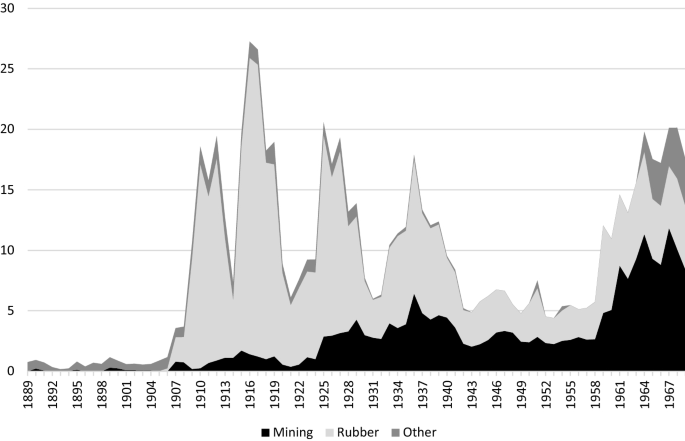
For developing and emerging economies there is enormous demand and need for English in public education systems to boost stability employability and prosperity. Tin mining also attracted attention from European mainly British investors who again introduced new technology such as high-pressure hoses to wash out the ore the steam pump and from 1912 the bucket dredge floating in its own pond which could operate to even deeper levels.
The Beginning Of Industrialization In Britain Foundations Of Western Culture

Changes to everyday life.
Effect british development of the tin industry. Reasons for Low Industrial Development in India. The British created an integrated Indian market. Harmful effects of excess Pb on the human body are well documented Pb gets into the body only through inhalation or ingestion Acts as a neurotoxin inhibits hemoglobin production effects brain development Children are more susceptible than adults Dramatic reduction in blood Pb levels since 1975 due mainly use of Pb-free gasoline.
Effects of the development New Englands textile industry. It greatly increased the importance of trade from between 1-2 of national income to more than 20 by 1913. Coal iron lead copper tin limestone and water power were also readily available for the British to use for their industrial advancement.
Thomas and Percy Gilchrist who invented the basic slag process in which the furnace or converter was lined with an alkaline material with which the phosphorus could combine to produce a phosphatic slag. During the early days of its development the gramophone was viewed as a scientific novelty that posed little threat to sheet music because of its poor sound quality. Tin is mainly applied in various organic substances.
Industries in the Inter-War Period 1919-38 4. Tin Market - Growth Trends COVID-19 Impact and Forecasts 2021 - 2026 The Tin Market is segmented by Product Type Metal Alloy and Compounds Application Solder Tin Plating Specialized Alloys Lead-acid Batteries Chemicals and Other Applications End-user Industry Automotive Electronics Packaging Glass and Other End-user Industries and Geography Asia-Pacific North. Early Efforts of Industrialisation 3.
The Lowell Factory System in the North introduced a new system of textile manufacturing in which all stages of production were done under one roof with employees mostly women and children living in company housing and away from home and family. Government felt enough progress had been made in the development of planes to warrant something totally new - the transport of mail by air. They were an immense improvement on the old open fires since they had built-in ovens and tanks for heating water.
English changes lives. As technology improved cotton picking became easier and was a booming industry. Health effects of tin.
While not creating a fully-fledged consumer culture as in the United States during the same decade it had an important effect over British society primarily on the middle classes which gained access to commodities previously reserved for the upper crust primarily automobiles ownership rising tenfold during the interwar period from around 500000 in 1919 to approximately over 3 million in 1929 and 5. Industries during 1939-47 5. This in turn became an important raw material in the nascent artificial-fertilizer industry.
By 1917 the US. Underdeveloped countries are greatly handicapped by shortage of capital for industry and enterprise. The salvation of the US.
The tin industry remained chiefly in immigrant Chinese hands through the 19th century but more highly capitalized technologically sophisticated British firms took over much of the tin. In the 1920s Tin Pan Alleys dominance of the popular music industry was threatened by two technological developments. Subject Matter of Industrial Development 2.
Despite the dangers they are applied in a great number of industries such as the paint industry and the plastic industry and in agriculture through pesticides. In the bathroom water could be heated by gas powered geysers which were terrifying to the user but a blessing to the. By 1931 British firms accounted for more than two-thirds of total tin production having displaced the earlier dominance of Chinese owners.
This coal was widely available in 18th-Century Britain. The earliest bronze objects had tin or arsenic content of less than 2 and are therefore believed to be the result of unintentional alloying due to trace metal content in the copper ore It was soon discovered that the addition of tin or arsenic to copper increased its hardness and made casting much easier which revolutionized metal working techniques and brought humanity from the Copper Age or Chalcolithic to the Bronze. The net result was that whereas in 1912 some 80 per cent of Malayas tin production was under Chinese management by 1931 British firms accounted for more than 65 per cent of total tin production.
These developments stimulated growth in the tin and rubber industries to meet world demand. Commercial aviation industry following World War I was a government program but one that had nothing to do with the transportation of people. The number of applications of organic.
They unified weights measures and the currency abolished transit duties and introduced a legal framework which promoted private property rights and contract law more explicitly. The most important effect of this innovation was to make. By the 1860s iron cooking ranges had arrived in most middle-class kitchens.
The advent of electrical recording and the rapid growth of radio. Moreover British rule had some distinctly positive effects. The remarkable ascendency of the tin industry resulted from the increasing use of tinplate cans in the preservation of food with American consumption accounting for about a quarter of world demand.
In rubber plantations also European plantation companies largely British were the dominant players. The problem was solved by the British scientists SG. 1 In conjunction with the navigable waterways in Britain these ships could transport much larger amounts of coal than land modes.
Longer work days and worse factory conditionsEx. The present author first became interested in the Roman pewter industry whilst researching the development of the early tin industry of South-West England and has undertaken a reassessment of the evidence for the composition distribution manufacture and dating of Roman pewter in the light of recent research and examination of unpublished finds in. The organic tin bonds are the most dangerous forms of tin for humans.
In conclusion this study focuses on the impact of the Industrial Revolution on the British society and economy. Subject Matter of Industrial Development. The impact of globalisation and economic development has made English the language of opportunity and a vital.
In the course of analysis this essay have develop the Industrial Revolution lead to several factors as overcrowding child labour working conditions for workers especially the youth the Luddites movement and organisation of workers to improve their rights.

History Of The Industrial Revolution New World Encyclopedia
The Beginning Of Industrialization In Britain Foundations Of Western Culture


Comments
Post a Comment